Soccer at a Glance
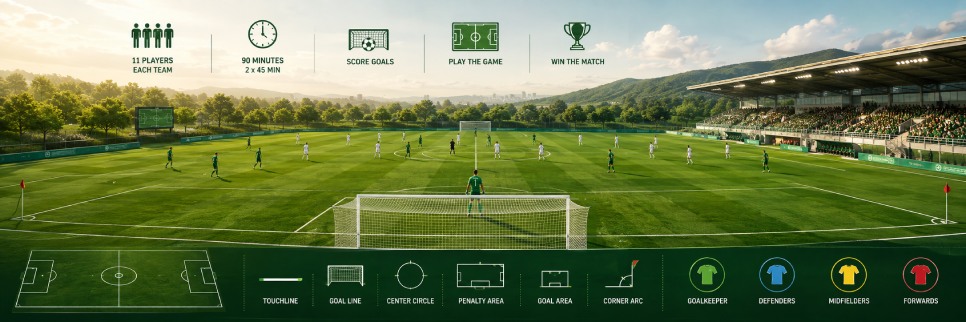
Two teams, one ball, and 90 minutes to decide who scores more. That is the basic structure of soccer. Each team normally fields 11 players, including one goalkeeper, and a match cannot begin if either side has fewer than seven players.
The objective is to score more goals than the opposing team. A goal counts when the entire ball crosses the goal line between the posts and beneath the crossbar. Players may score using any legal part of the body, but outfield players cannot deliberately use their hands or arms.
A standard match consists of two 45-minute halves separated by a halftime interval of up to 15 minutes. Additional time may be added at the end of each half to account for stoppages. In competitions where a winner is required, a tied match may continue into extra time and, if necessary, a penalty shootout.
Soccer is played on a rectangular grass or artificial-turf field. For international matches, the field is generally 100–110 meters long and 64–75 meters wide. Players are typically divided into four main positional groups: goalkeeper, defenders, midfielders, and forwards, with each group performing different defensive, creative, or attacking responsibilities.
Soccer Rules Explained
Most of what happens in a soccer match follows a clear pattern once you know what to look for. Play stops, something happens, play restarts. Understanding those moments makes the game much easier to follow.
How Play Starts and Restarts
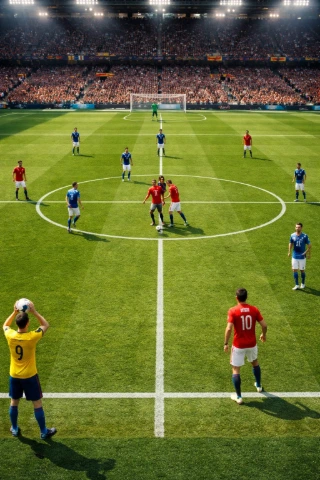
Kickoff opens each half and resumes play after a goal. One team passes the ball from the center circle, and the match is underway. When the ball crosses a touchline, the opposing team restarts with a throw-in – both feet must stay on the ground. A ball crossing the goal line last touched by an attacker means a goal kick for the defending team. Last touched by a defender, and the attacking team gets a corner kick from the nearest corner arc.
Free Kicks, Penalties, and Fouls
Fouls such as tripping, pushing, holding, or deliberate handball may result in a free kick for the opposing side. Direct free kicks can be aimed straight at goal, while indirect free kicks must touch another player before a goal can count. When a defender commits a direct-free-kick offense inside their penalty area, the attacking team receives a penalty kick from 12 yards, with only the goalkeeper defending the goal.
Cards and Substitutions
Yellow cards are used to caution players for offenses such as reckless challenges, repeated fouls, dissent, or delaying the restart of play. Receiving two yellow cards in the same match results in a red card and dismissal. A straight red card can also be shown for serious misconduct, leaving the team with one fewer player. Substitution rules vary by competition, but many modern competitions allow up to five substitutions, usually made during a limited number of substitution opportunities.
Added Time
Referees keep track of time lost during each half because of injuries, substitutions, disciplinary actions, goal celebrations, video reviews, and other delays. This time is added after the 45 minutes and is known as added or stoppage time. The fourth official usually indicates the minimum number of extra minutes to be played. Added time often lasts several minutes but can be longer when play has been interrupted repeatedly. The referee may also extend it if delays occur during stoppage time.
Soccer Field Dimensions and Markings
Knowing the layout of the field makes the rules much easier to follow. Where the ball lands, which line it crosses, and which zone a player is standing in all determine what happens next in a match.
Touchlines
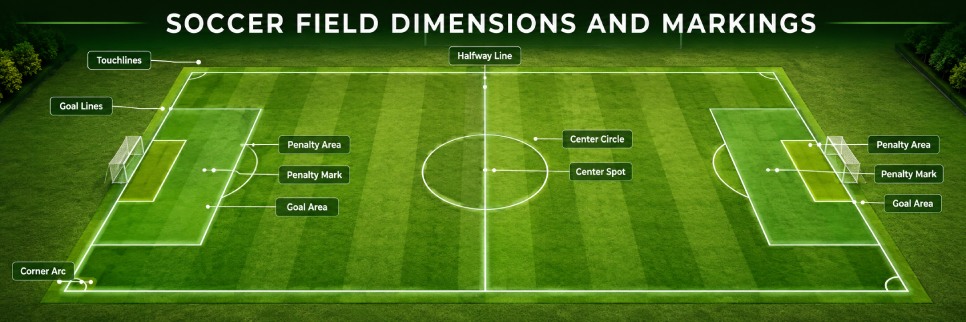
The touchlines form the long outer edges of a soccer field. If the whole ball passes over one of these lines, either along the ground or through the air, the referee stops play. Possession is awarded to the opposing team, which resumes the game with a throw-in taken close to the point where the ball went out.
Goal Lines
Goal lines run across the two short ends of the field and pass beneath each goal. A goal is scored when the entire ball crosses the line between the posts and under the crossbar. If it crosses elsewhere, play restarts instead with either a goal kick or a corner kick.
Halfway Line and Center Circle
The halfway line divides the field into two equal halves and passes through the center spot, where kickoffs begin. Around that spot is the center circle, which has a radius of 10 yards. During a kickoff, opposing players must remain outside the circle until the ball is put into play.
Penalty Area and Penalty Mark
Extending 18 yards from each goal, the penalty area is where the goalkeeper can use their hands. Fouls committed inside this box by the defending team result in a penalty kick, taken from the penalty mark 12 yards out.
Goal Area and Corner Arcs
The smaller box inside the penalty area is the goal area, used to position goal kicks. Corner arcs mark where corner kicks are taken from – one small arc sits at each of the four corners of the field.
Soccer Positions and the Offside Rule
Teams divide the field by assigning players specific positions that shape how attacks are built and how defenses hold shape. Understanding those roles – and the offside rule that governs attacking movement – makes match action far easier to follow.
Goalkeeper
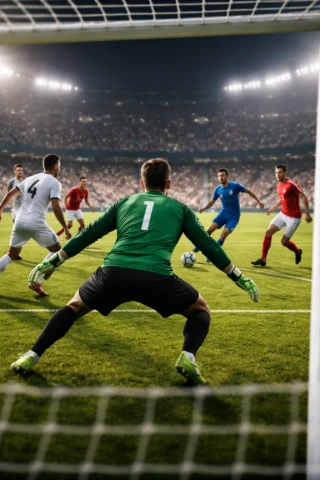
The goalkeeper is the last line of defense, stationed in front of the goal. This is the only player allowed to use their hands, but only within their own penalty area. Stopping shots, organizing defenders, and distributing the ball after a save are the core responsibilities.
Defenders
Center backs hold the central defensive positions and deal directly with opposing strikers. Fullbacks operate on the left and right flanks, tracking wide attackers and occasionally joining attacks. Wingbacks push even higher up the flanks than fullbacks, functioning almost as wide midfielders in certain formations.
Midfielders
Defensive midfielders sit just in front of the back line, breaking up opposition plays. Central midfielders link defense to attack and cover a lot of ground. Attacking midfielders operate closer to the forwards, looking to create chances. Wide midfielders – sometimes called wingers – hug the touchlines and stretch opposing defenses.
Forwards
Strikers and center forwards occupy the most advanced positions, with finishing goals as their primary job. Wingers play wide and use pace or skill to get behind defenders and deliver crosses or cut inside to shoot.
The Offside Rule
A player is considered to be in an offside position when they are closer to the opposing goal line than both the ball and the second-last opponent. Simply standing there does not result in a violation. An offside offense occurs only if the player becomes involved in active play, such as receiving the ball, challenging an opponent, or benefiting from their position.
The second-last defender is the reference point. If an attacker is level with or behind that defender when the ball is played, they are onside. Throw-ins and corner kicks are exceptions – a player cannot be offside directly from either of those situations.
The rule exists to prevent attackers from simply camping near the opposing goal waiting for long passes. It forces teams to time their runs carefully.
The Game Makes Sense Once the Basics Click
Knowing the objective, the match structure, and how restarts work changes the viewing experience entirely. A throw-in stops feeling random when you know it follows the ball crossing a touchline. A corner kick makes sense when you understand why it's awarded instead of a goal kick. Learning the field markings gives context to where play happens and why officials position themselves where they do. Positions explain why certain players stay back while others push forward. And the offside rule, often the most confusing part for newcomers, becomes logical once you see it as a way to prevent easy goal-hanging. With these fundamentals in place, watching a match shifts from passive confusion to active understanding – there's no denying that's a different experience altogether.